Understanding Tyre Wear Particles Emissions, Pathways & Risks

What are tyres made of? Vehicle tyres are more than just rubber. In fact, natural rubber accounts for just 19% of a car tyre, with synthetic polymers accounting for 24%, fillers for 26% and additive chemicals 14%. Tyre design is optimized to deliver high performance in key areas such as safety, (wet)grip, rolling resistance, and noise reduction.
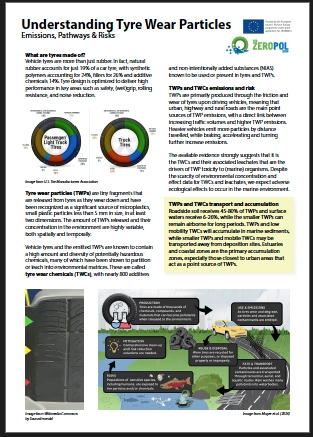
Understanding Tyre Wear Particles Emissions, Pathways & Risks

Related Resources

Factsheet 4 Interviews on PFAS
This poster dives into expert insights on PFAS contamination, showing perspectives from scientists and policy advisors in the Netherlands. These insights were collected by Wageningen University studen[...]
Type: File
Factsheet PFAS Overview and the Black Sea
Factsheet about PFAS providing an overview of usage, emissions and health effects as well as zooming in on the issue in the Black Sea and its drainage basin. This factsheet was developed for the Livin[...]
Type: File
Factsheets PFAS and Tyre Wear Particles developed for Living Labs
Check out our factsheets about PFAS and Tyre Wear Particles developed for the first round of Living Labs.[...]
D4.4 Case Study Pollutant Factsheets
Executive Summary D4.4 ‘Case Study Pollutant Factsheets’ was developed in collaboration with WP6 and contains the finalised and combined ‘Integrated Analysis and Scenario Development’ (M4.1 &#[...]
Type: File
Factsheet Enzymatic degradation of PFAS
Factsheet about enzymatic degradation of PFAS [...]
Type: File
Understanding PFAS Usage, emissions, and risks
There are large differences between PFAS in how they move through the environment. Some are relatively volatile and travel long distances through the atmosphere, while others are highly water-soluble,[...]
Type: File
Factsheet PFAS Product Chains
This factsheet provides an overview of PFAS in three product chains: Agriculture (pesticides), Textiles, and Cosmetics. The factsheet was developed by students at Wageningen University. [...]
Type: File