file Library
D5.2 Tyre wear particles guidance to zero pollution in our seas
TWPs are an increasingly important but often overlooked source of pollution in European aquatic environments. Generated continuously through vehicle use, TWPs consist of both particles and a complex mixture of associated chemicals (TWCs), many of which are toxic, persistent, and poorly [...]
D5.5 Roadmap
The SOS-ZEROPOL2030 Dashboard is an interactive decision-support tool that transforms Europe’s Zero Pollution ambition into a practical roadmap for action. Built on the SOS-ZEROPOL2030 Roadmap, it connects long-term environm [...]
D5.1 Strategic Zero Pollution Framework
A strategic framework developed under the EU Horizon Europe SOS-ZEROPOL2030 project, outlining practical objectives, targets and actions to help achieve zero pollution in European seas by 2030 and beyond. The report focuses on four priority pollutant groups, nutrients, hazard [...]
D5.6 Report of the zero-pollution parliament outlining the EU scenario to achieve zero pollution
Suggested Citation:
Kopke K., van Leeuwen J., Boteler B., Del Savio L.., Ruhl R., Vlachogianni T., Shivarov A., Strietman W.J., Booth A., Hendriksen A. (2026). SOS-Zeropol2030: Deliverable D5.6 Report of the zero-pollution parliament outlin [...]
D4.4 Case Study Pollutant Factsheets
Executive Summary
D4.4 ‘Case Study Pollutant Factsheets’ was developed in collaboration with WP6 and contains the finalised and combined ‘Integrated Analysis and Scenario Development’ (M4.1 – M4.3). D4.4 comprises a 3-page factsheet about per- and p [...]
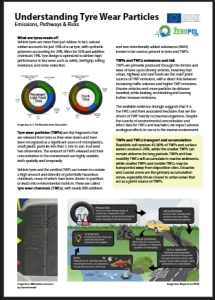
Understanding Tyre Wear Particles Emissions, Pathways & Risks
What are tyres made of? Vehicle tyres are more than just rubber. In fact, natural rubber accounts for just 19% of a car tyre, with synthetic polymers accounting for 24%, fillers for 26% and additive chemicals 14%. Tyre design is optimized to deliver high performance in [...]
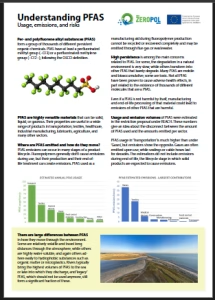
Understanding PFAS Usage, emissions, and risks
There are large differences between PFAS in how they move through the environment. Some are relatively volatile and travel long distances through the atmosphere, while others are highly water-soluble, and again others adhere easily to hydrophobic substances such as orga [...]
D4.3 Exploratory scenarios for zero marine pollution in three EU regional seas
The case of PFAS in the Nort-East Atlantic and the Black Sea regions, and TWPs in the Mediterranean Sea region
Citation
Van Hulst, F., Hendriksen, A., Booth, A., Gileva, E., Kopke, K., Ruhl, R., Shivarov, A., Strietman, WJ., Vlachogianni, T [...]
D4.1 Knowledge and outcomes from T4.1- T4.4 summarised in the ‘integrated analysis’ section of the individual case study pollutant template. Part B
Part B: Tyre Wear Particles (TWPs)
Citation: Booth, A.M., Sørensen, L., Maes, T., Hansen, B.H., Nepstad, R., Ruhl, R., Fylakis, G., Blaauw, R., Thoden van Velzen, U., Igartua, A., van Hulst, F., Del Savio, L., Cowan, E., van Leeuwen, [...]
D4.1 Knowledge and outcomes from T4.1-T4.4 summarised in the ‘integrated analysis’ section of the individual case study pollutant template. Part A
Part A: Per- and polyfluoroalkyl substances (PFAS)
Citation: Ruhl, R., Blaauw, R., Thoden van Velzen, U., Booth, A.M., Sørensen, L., Maes, T., Hansen, B.H., Nepstad, R., Igartua, A., Fylakis, G., van Hulst, F., Del Savio, L., Cowan, [...]