Fact Sheets Library
D4.4 Case Study Pollutant Factsheets
Executive Summary
D4.4 ‘Case Study Pollutant Factsheets’ was developed in collaboration with WP6 and contains the finalised and combined ‘Integrated Analysis and Scenario Development’ (M4.1 – M4.3). D4.4 comprises a 3-page factsheet about per- and p [...]
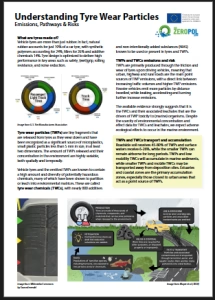
Understanding Tyre Wear Particles Emissions, Pathways & Risks
What are tyres made of? Vehicle tyres are more than just rubber. In fact, natural rubber accounts for just 19% of a car tyre, with synthetic polymers accounting for 24%, fillers for 26% and additive chemicals 14%. Tyre design is optimized to deliver high performance in [...]
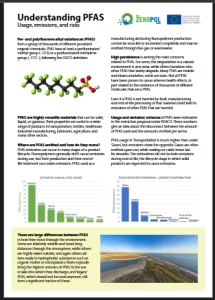
Understanding PFAS Usage, emissions, and risks
There are large differences between PFAS in how they move through the environment. Some are relatively volatile and travel long distances through the atmosphere, while others are highly water-soluble, and again others adhere easily to hydrophobic substances such as orga [...]
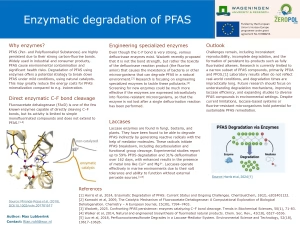

Factsheet 4 Interviews on PFAS
This poster dives into expert insights on PFAS contamination, showing perspectives from scientists and policy advisors in the Netherlands. These insights were collected by Wageningen University students through interviews with an environmental geographer, a water board policy advisor, a [...]

Factsheet Wageningen University PFAS Awareness
Wageningen University (WUR) students and researchers were tested on their awareness of PFAS, the ‘forever chemical’. The results show interesting insights on knowledge of the subject, concern over its risks, and how consumer habits are influenced within WUR. The survey and f [...]
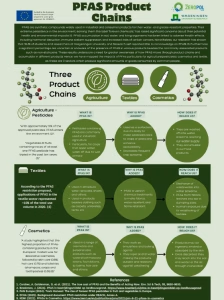
Factsheet PFAS Product Chains
This factsheet provides an overview of PFAS in three product chains: Agriculture (pesticides), Textiles, and Cosmetics. The factsheet was developed by students at Wageningen University.

Factsheet PFAS in the Medical Products Chain
Factsheet about PFAS in the medical products chain and medical applications exploring usage, emissions and health effects. This factsheet was developed for the Living Lab in the North-East Atlantic Sea Region.